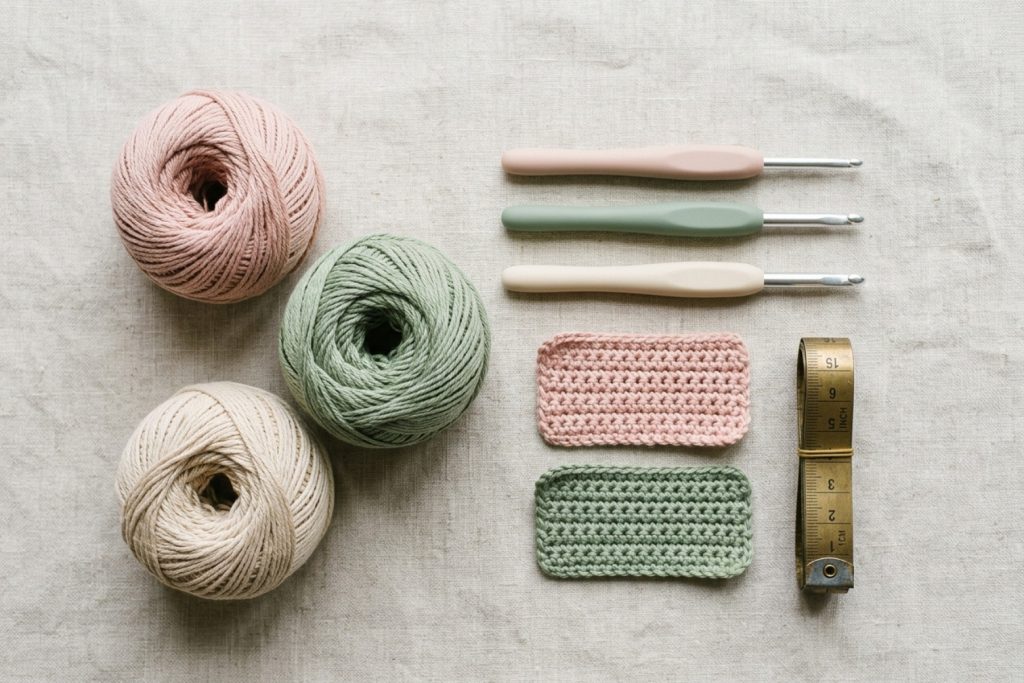
The best starting point for amigurumi materials is the pattern’s own yarn and hook recommendation. Changing those materials can change the size, fabric, and appearance of the project. A larger hook or a thicker yarn is not simply a way to make the same toy faster: the finished shape may behave differently.
Start with the pattern’s materials list
Write down the yarn type, approximate thickness, ball weight and length, recommended hook, and any special materials. A pattern may also need stuffing, a tapestry needle, stitch markers, eyes, or an internal support. Check those items before choosing the project, especially if it is intended as a gift.
If you are replacing a yarn, compare both the weight category and the length per ball. Two yarns labeled with the same broad category can produce noticeably different fabrics. You can read more about broad categories in the Craft Yarn Council’s yarn weight system; its hook ranges are guides, rather than a substitute for your pattern.
Compare fibers by the fabric you want
Smooth cotton often makes individual stitches easier to see and can give a firm, defined fabric. Acrylic yarn offers many colors and weights, but its feel and behavior vary by product. Plush and chenille yarns create a different surface and may make small stitches harder to identify. None of these descriptions guarantees a result for every brand.
For an early practice project, a smooth, light-colored yarn can make counting easier than a very dark or highly textured yarn. If the pattern was designed for plush yarn, switching to thin cotton will not automatically reproduce the same proportions or texture. Compare the designer’s notes before substituting.
Use a sample to choose the hook
The number printed on the hook is a starting point. Make a small sample in the stitch used by the pattern, with the yarn you plan to use. Inspect the fabric while gently shaping it, since a piece that looks closed when flat can show gaps when filled.
If stuffing would show through, consider a smaller hook or a different yarn and make another sample. If the fabric is so stiff that inserting the hook is uncomfortable, do not keep tightening your grip. Revisit the hook and yarn combination. Avoid treating “use a tiny hook” as a universal rule.
Think about size before swapping materials
A thicker yarn commonly makes a larger piece, but the final change depends on stitch gauge and construction. A head, body, clothing, and accessories may not scale identically if you mix different substitute yarns. When a project has fitted pieces, use the same sample-based approach for each important fabric.
Our crochet gauge guide explains how to compare a sample with the stated measurements. If a pattern gives an approximate height without a gauge, treat that height as an indication based on the designer’s materials, not a guaranteed measurement for every yarn.
Plan colors and quantities together
List the main color, accent colors, and any small details separately. Check the quantity stated for the actual yarn used, rather than assuming that one ball of any substitute will be enough. Where color matching matters, compare dye lots before starting and keep the ball bands with your project notes.
For a gift, choose colors you can obtain consistently and check the care instructions for every component. A yarn that can be washed in a particular way does not mean the finished item, including eyes, stuffing, decorations, and supports, can be treated in the same way.
Keep a short project record
Record the yarn brand and color, hook size, pattern name, and any changes you make. Add a photograph of the sample if it helps you compare future projects. These notes are particularly useful if you put a project aside or want to make a matching item later.
When choosing a paid pattern, check the supplied language and materials information on the product page. For a simple first exercise before committing to a larger project, visit our free crochet practice pattern.